

Table of Contents
There is a sentence audiologists hear remarkably often: “I can hear people talking. I just cannot make out what they are saying.”
At first, that can sound contradictory. If a voice is loud enough to hear, surely the words should also be understandable?
Not necessarily.
Detecting sound and understanding speech are related, but they are not the same ability. A person may know that someone is speaking, recognise the rhythm of the sentence and even judge whether the voice is male or female, yet still miss the small acoustic details that distinguish one word from another.
The difference becomes especially noticeable in restaurants, family gatherings, meetings, cars and other places where speech competes with background noise.
From an audiological perspective, this is an important distinction. Simply making sound louder does not always restore clarity. To understand why someone is struggling, we need to look beyond whether they can hear a sound and ask how effectively the auditory system is handling speech.
An audiogram tells us something essential, but not everything
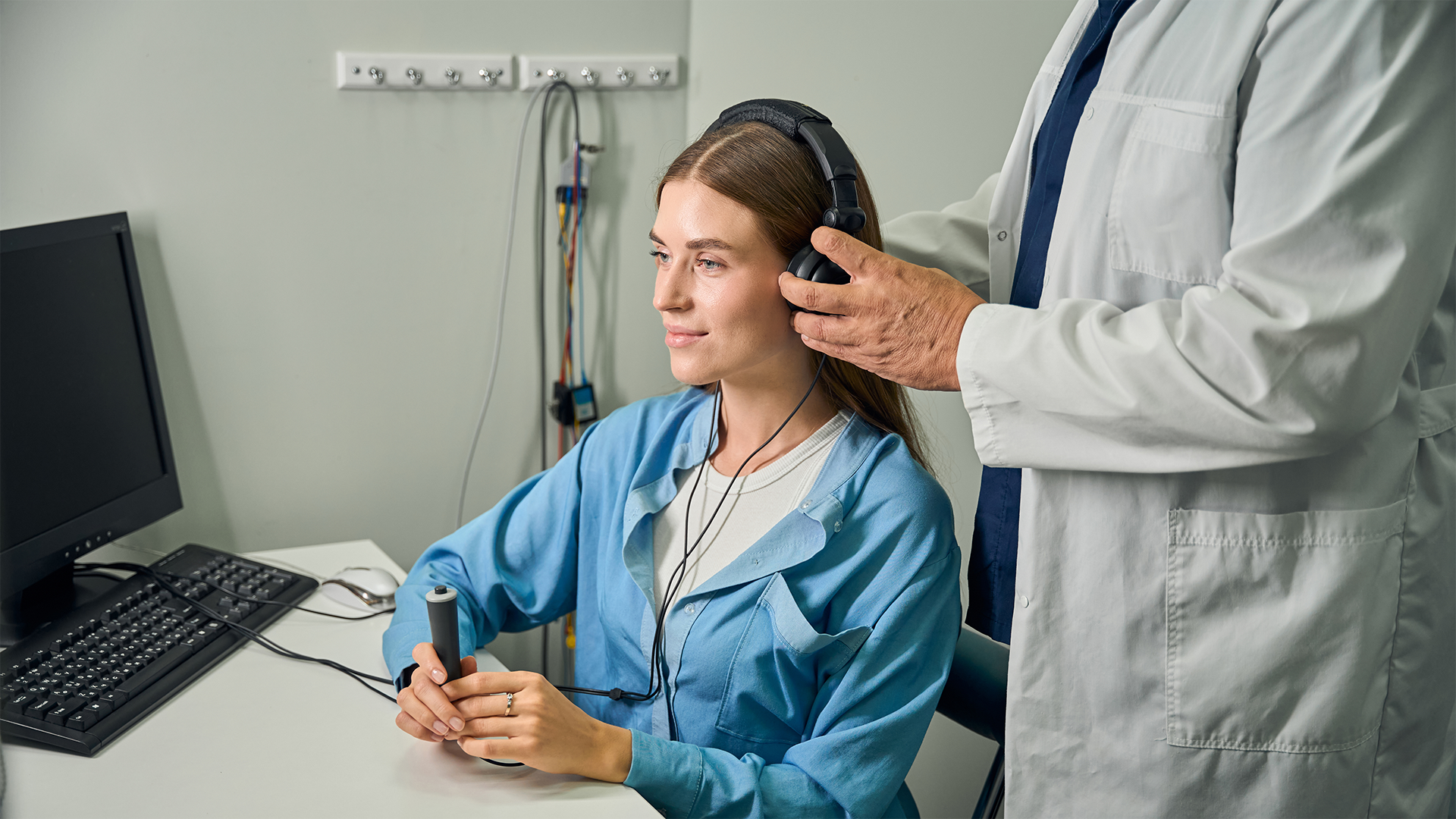
Pure-tone audiometry remains one of the foundations of hearing assessment.
During the test, tones at different frequencies are presented at progressively softer levels to establish the quietest sounds a person can reliably detect. The resulting audiogram shows hearing sensitivity across the frequency range and can reveal the degree, configuration and symmetry of a hearing loss.
That information is extremely valuable.
What the audiogram does not do is reproduce everyday communication.
The test normally takes place in controlled, quiet conditions. There are no competing conversations, clattering plates, traffic sounds or reverberation. The listener is also waiting specifically for a sound and knows exactly what task to perform.
Conversation is considerably more complicated.
Speech changes continuously in frequency, intensity and timing. Words arrive quickly. Some sounds are masked by others. The listener has to identify the speaker, separate the voice from competing sound, recognise individual speech cues and connect them into meaningful language.
For this reason, two people with broadly similar audiograms can report very different levels of difficulty in daily life.
The audiogram should therefore be interpreted as one important measurement within a wider assessment, rather than as a complete description of how somebody communicates.
This becomes particularly relevant when a person says, “My hearing test does not look that bad, but I still cannot follow conversations.”
The complaint and the audiogram are not necessarily contradicting each other. They may simply be measuring different aspects of hearing.
Speech can be loud enough without being clear enough
Consider the difference between hearing that a radio is switched on and understanding every word being spoken.
Increasing the volume may make the presence of speech obvious. It does not automatically restore acoustic detail that the auditory system is no longer receiving or encoding effectively.
This is particularly relevant in sensorineural hearing loss, where changes within the cochlea can reduce both sensitivity to sound and the precision with which some acoustic information is represented.
High-frequency hearing is especially important for many speech cues.
A substantial amount of the energy in vowels lies at lower frequencies, while many consonant cues extend into higher frequencies and are softer. Sounds such as /s/, /f/, /th/, /sh/ and parts of /t/ can therefore become less accessible when high-frequency hearing declines.
The result is often not silence. It is ambiguity.
Someone may hear the general shape of a sentence but confuse words that differ by relatively subtle consonant information. Speech can begin to sound as though people are mumbling, even when they are speaking normally.
Context then becomes increasingly important.
If someone says, “Please put the ___ on the table,” the listener may reconstruct the missing word from the situation. That strategy works surprisingly well, which is one reason gradual hearing changes can remain unnoticed for years.
But guessing requires additional effort, and it becomes much less reliable when the conversation is unfamiliar, fast or noisy.
This also explains why increasing the television volume may help up to a point but fail to solve the underlying problem. Loudness can improve audibility. It cannot always restore clarity.
Background noise exposes the difference very quickly
Many people first notice this problem not in quiet conversation, but in noise.
A one-to-one discussion at home may remain comfortable. Move the same conversation into a busy restaurant and suddenly whole pieces of speech disappear.
Background sound creates several problems simultaneously.
First, it can physically mask parts of speech. If competing noise contains energy in similar frequencies at the same moment, some speech cues become harder to detect.
Second, there may be several voices competing for attention. The listener must decide which sound source to follow and continuously separate that voice from everything else.
Third, rooms themselves can make the problem worse. Hard surfaces create reverberation, causing previous sounds to persist briefly and overlap with the speech that follows.
People with hearing loss often require a more favourable relationship between the level of the speaker and the level of background noise than people with better hearing.
This relationship is known as the signal-to-noise ratio.
That is why simply saying “the restaurant was not very loud” can be misleading. What matters is not only the absolute volume of the room, but how clearly the target voice stands out from everything competing with it.
Distance matters too.
Move further away from the person speaking and their voice becomes weaker, while much of the surrounding noise remains. A conversation that is manageable across a small table may become difficult only a few metres away.
These are real acoustic effects, not failures of concentration.
Attention, fatigue, familiarity with the speaker, language and many other individual factors can also influence performance. But when difficulties repeatedly appear in noise, the assessment should examine that specific complaint rather than relying solely on testing performed in silence.
Speech audiometry asks a different question
This is where speech testing adds important information.
Instead of asking whether somebody can detect a tone, speech audiometry examines how the auditory system responds to spoken material.
Different forms of speech testing answer different clinical questions.
A speech reception threshold can help establish the level at which familiar speech becomes recognisable and can provide a useful cross-check against pure-tone results.
Word-recognition testing examines how accurately a person identifies spoken words when they are presented at an audible level.
This matters because audibility and recognition do not always improve together.
For one person, making speech sufficiently audible may produce excellent word recognition. For another, recognition may remain poorer even when the words are comfortably loud.
That difference affects counselling and expectations.
If hearing aids are being considered, for example, it is important to understand that amplification is designed to improve access to sound. The benefit a person experiences also depends on how effectively the auditory system can use the information that becomes available.
Speech testing is therefore not simply an additional score beside the audiogram. It helps the audiologist understand the relationship between loudness and clarity.
Interpretation also has to be individual.
Results can be influenced by the speech material used, presentation level, test language, accent and method of administration. Someone being tested in a language that is not their strongest language may perform differently for reasons that are not purely auditory.
A percentage should never be interpreted without that context.
Speech-in-Noise testing brings the assessment closer to real life
When a patient says, “I manage perfectly well in this room, but I cannot understand anyone in restaurants,” testing only in quiet leaves the central complaint unanswered.
Speech-in-Noise testing deliberately introduces competing sound.
Depending on the test, the listener may be asked to repeat words or sentences while the relationship between speech and background noise changes. The result provides information about how favourable the signal-to-noise ratio needs to be for that individual to understand speech successfully.
At AudioCare, this can include QuickSIN assessment when clinically appropriate.
The value is not simply to prove that noise is difficult. Most people find speech harder to understand when sufficient competing noise is added.
The useful information is how much difficulty an individual experiences and how that result relates to their audiogram, speech testing and everyday complaints.
AudioCare also offers Audible Contrast Threshold testing. ACT examines sensitivity to spectro-temporal modulation rather than asking the listener to identify spoken words. It provides a different form of information about auditory contrast that can be useful when assessing performance in complex sound and, where appropriate, when supporting hearing-aid fitting decisions.
Neither Speech-in-Noise testing nor ACT replaces the audiogram.
They answer different questions.
Pure-tone audiometry asks: what sounds can you detect?
Speech audiometry asks: how accurately can you recognise speech under specified conditions?
Speech-in-Noise testing asks: what happens when speech has to compete with other sound?
Together, these measurements can provide a much richer description of someone’s hearing than any single result in isolation.
The right answer is individual, not just louder
When someone can hear a voice but continually misses the words, it is tempting to assume that the solution is simply more volume.
Sometimes additional audibility is exactly what is needed.
Sometimes it is only part of the answer.
A proper assessment should establish the hearing thresholds of each ear, examine speech recognition and explore the situations in which communication actually breaks down. If difficulty is concentrated in noisy environments, Speech-in-Noise assessment can add information that the standard audiogram cannot provide.
The person’s own experience remains essential.
Do they struggle with one speaker or mainly with groups? Is the television difficult even in a quiet room? Are certain voices easier than others? Does moving closer solve the problem? Is one ear noticeably better? Do difficulties occur in English but less in another familiar language?
Those details are not secondary to the test results. They help us interpret them.
At AudioCare, hearing assessment is therefore not about reducing an individual to a line on an audiogram. Pure-tone results, speech measures and real-world listening difficulties need to be considered together.
This distinction also matters when hearing aids are appropriate.
The aim is not simply to make every sound louder. Amplification needs to provide useful access to speech while remaining comfortable, and fittings should be verified and adjusted according to the hearing profile and communication needs of the individual.
Two people can hear the same tones on an audiogram and still experience a crowded room very differently.
That is why “I can hear you, but I cannot understand you” is not a contradiction.
It is clinically useful information.
And often, it is the point at which a hearing assessment needs to move beyond asking how softly you can hear and begin investigating how clearly you can understand.

References
- https://www.thebsa.org.uk/wp-content/uploads/2023/10/OD104-32-Recommended-Procedure-Pure-Tone-Audiometry-August-2018-FINAL-1.pdf
- https://www.thebsa.org.uk/wp-content/uploads/2023/10/OD104-80-BSA-Practice-Guidance-Speech-in-Noise-FINAL.Feb-2019.pdf
- https://www.nice.org.uk/guidance/ng98
- https://www.nidcd.nih.gov/health/age-related-hearing-loss
https://audiocare.pt/pure-tone-speech-audiometry/ - https://audiocare.pt/speech-in-noise-act-test/
- https://audiocare.pt/speech-audiometry-why-hearing-isnt-understanding/
- https://audiocare.pt/speech-in-noise-testing-clarity-where-it-matters/