
Table of Contents
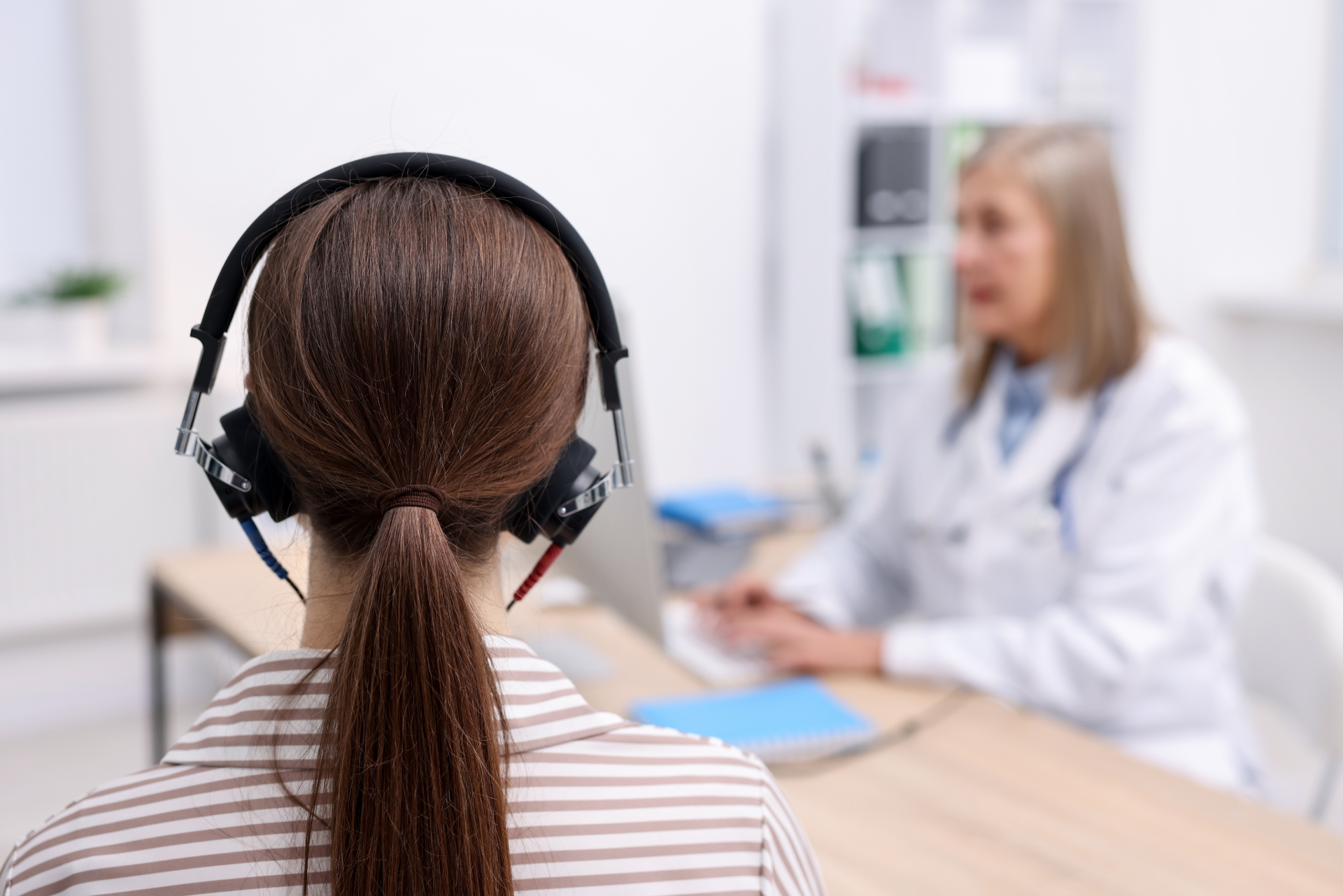
Most people who have had a hearing test recognise the basic routine: headphones, a series of tones and a button to press whenever a sound becomes audible.
What many do not realise is that a conventional audiogram examines only part of the frequency range the human auditory system can detect.
Routine pure-tone audiometry usually concentrates on frequencies up to 8 kHz. That range is clinically important because it contains much of the information needed to assess everyday hearing and understand common patterns of hearing loss.
But the cochlea does not stop responding at 8 kHz.
High-frequency, or extended high-frequency, audiometry takes the assessment further, typically examining frequencies above 8 kHz. At AudioCare, testing can extend into the 9–16 kHz region using equipment calibrated specifically for these frequencies.
Does that automatically make it a “better” hearing test? No.
It answers a different question.
Used in the right clinical context, high-frequency audiometry can reveal information that would otherwise sit outside the standard audiogram. Used without context, however, a reduced response at 12 or 16 kHz may tell us surprisingly little.
The value lies not in testing more frequencies for the sake of it, but in knowing when those additional measurements can change our understanding of someone’s hearing.
The standard audiogram has a deliberate limit
Conventional pure-tone audiometry is not incomplete simply because it normally stops at 8 kHz.
Its frequency range has been chosen because it provides clinically useful information about hearing sensitivity across frequencies that are highly relevant to communication and to the identification of many common types of hearing loss.
A standard audiogram can show whether hearing is within expected limits, whether a loss is mild or more significant, whether one ear differs from the other and whether the pattern suggests conductive, sensorineural or mixed involvement when combined with bone-conduction testing.
For most routine assessments, that information is fundamental.
What it cannot tell us is what is happening at frequencies it does not measure.
Imagine a patient whose thresholds between 250 Hz and 8 kHz are within conventional limits but who reports tinnitus or a subtle change in hearing following a period of significant noise exposure. A conventional audiogram may genuinely be normal. That does not mean the test has failed.
It means that within the frequency range examined, no threshold abnormality has been demonstrated.
Extending the test above 8 kHz allows the audiologist to examine another region of cochlear function.
The distinction matters because the basal region of the cochlea, which responds to higher frequencies, can be particularly susceptible to factors including ageing and certain ototoxic medications. Research also continues to investigate whether extended high-frequency measurements can reveal changes associated with noise exposure before conventional thresholds are affected.
This makes high-frequency audiometry an additional tool, not a replacement for the standard audiogram.
Where high-frequency testing can be especially useful
One of the clearest clinical applications is ototoxicity monitoring.
Some medicines can damage structures within the inner ear. Certain chemotherapy agents and aminoglycoside antibiotics are among the best-established examples, although the risk depends on the specific medication, dose, duration, individual susceptibility and other medical factors.
Ototoxic damage often affects higher-frequency regions first.
For that reason, extended high-frequency thresholds can be valuable when a patient is being monitored before, during or after treatment with a medication known to carry a clinically relevant ototoxic risk.
In this setting, an individual baseline can be particularly important.
Rather than simply asking whether a threshold is “normal” compared with a population reference, the clinician can compare later results with that person’s own previous measurements. A meaningful change may then be detected even when conventional frequencies remain relatively stable.
That is a very different use of the test from performing a one-off high-frequency audiogram in an otherwise healthy adult.
High-frequency audiometry may also be considered when someone reports auditory symptoms despite having conventional thresholds within expected limits.
A 2024 clinical study examined patients with auditory complaints whose conventional audiograms were normal up to 8 kHz. Extended testing identified high-frequency hearing loss in a substantial proportion of that selected group.
That does not mean everyone with a normal audiogram and hearing complaints has “hidden” high-frequency hearing loss. The study involved a specific clinical population, and its authors themselves called for more evidence to define when extended testing should routinely be used.
What it does show is that, in selected cases, looking beyond 8 kHz can add information that conventional audiometry cannot provide.
Noise exposure is interesting, but the interpretation requires caution
High-frequency audiometry is often described as a way to detect hearing damage from noise earlier than a standard audiogram.
There is evidence supporting that possibility, but the wording matters.
Research involving recreational noise and personal listening devices has found that some people with greater or longer exposure show poorer thresholds at extended high frequencies despite conventional audiograms remaining within normal limits.
A recent review of studies in younger listeners found that many reported differences in the 9–16 kHz region, particularly around 12–14 kHz, in groups with greater personal listening-device exposure.
But not every study found the same effect.
The research varies considerably in how listening exposure is measured, which frequencies are tested, what equipment is used and how participants are grouped. Self-reported listening habits also make precise exposure difficult to quantify.
So an elevated threshold at 14 kHz cannot be used as a simple biological receipt proving that headphones have damaged someone’s hearing.
Equally, a normal extended high-frequency result does not guarantee that no harmful exposure has occurred.
This is where clinical interpretation becomes more important than the extra data point.
An audiologist needs to consider age, noise history, symptoms, conventional thresholds, previous results and the reliability of the test before deciding what an extended high-frequency finding actually means.
The test can add sensitivity in certain situations. It does not remove uncertainty.
Age changes the meaning of the result
High-frequency hearing changes substantially across adulthood.
Even people with good conventional hearing frequently become less sensitive to very high frequencies as they grow older. The decline tends to become more pronounced as frequency increases.
This creates an important interpretative problem.
If a 65-year-old does not respond at 16 kHz, that observation does not carry the same meaning as an identical result in a 20-year-old.
Reference data for extended high frequencies are also less established and less uniform than those used for conventional audiometry. Studies in older adults have found considerable variation in thresholds between individuals, and researchers continue to highlight limitations in normative data at these frequencies.
The equipment matters as well.
Testing above 8 kHz requires appropriate transducers and calibration. Small differences in headphone placement can influence the measured threshold more at very high frequencies than clinicians are accustomed to seeing in the conventional range.
This is another reason why serial monitoring can be particularly informative.
If the aim is to detect change, comparing a patient with their own carefully obtained baseline may sometimes be more meaningful than comparing one isolated threshold with a broad population average.
High-frequency audiometry therefore produces numbers that require context.
A graph extending to 16 kHz may look more comprehensive, but more measurements do not automatically mean more certainty.
It does not replace speech testing or explain every hearing difficulty
There is another limitation that is particularly important for patients to understand.
High-frequency audiometry remains a pure-tone detection test.
It asks whether you can detect a tone at a particular frequency and level.
It does not directly measure how well you understand conversation.
Someone may have reduced extended high-frequency thresholds yet communicate very effectively in everyday situations. Another person may have conventional thresholds that look relatively good but experience substantial difficulty following speech in competing noise.
Those are different clinical questions.
Research has explored whether extended high-frequency hearing contributes to speech perception, particularly in challenging listening environments. There is evidence of an association, but the relationship is not simple enough to say that poor hearing above 8 kHz directly explains an individual’s difficulty understanding speech in noise.
Extended high-frequency loss may sometimes act as a marker of broader cochlear change rather than being the sole reason speech becomes difficult.
If the principal complaint is, “I can hear people but I cannot understand them in restaurants,” then speech audiometry and Speech-in-Noise testing may provide more directly relevant information.
If the concern is monitoring potential ototoxic change, establishing an extended high-frequency baseline may be considerably more important.
The right test depends on the question being asked.
That is why a comprehensive hearing assessment should not become a competition to perform the largest possible number of tests. Each measurement should contribute something clinically useful.
More frequencies are useful only when they answer the right question
High-frequency audiometry extends our view of hearing beyond the conventional 8 kHz boundary.
That additional information can be valuable.
It can support ototoxicity monitoring, provide a baseline for people at particular risk, and add another layer of investigation when auditory symptoms are not fully explained by conventional findings.
It may also identify high-frequency changes associated with ageing, noise exposure or other factors that would simply not appear on a standard audiogram.
But the test needs proportion.
It does not predict the future of someone’s hearing with certainty. It does not diagnose noise damage from a single threshold. It does not replace speech testing, and an abnormal result above 8 kHz does not automatically mean that everyday communication will be impaired.
At AudioCare, the useful question is therefore not simply whether high-frequency audiometry can be added to an assessment.
It is whether it should be added for this person.
A patient undergoing ototoxic treatment presents a different clinical question from someone investigating tinnitus. A young musician with substantial sound exposure presents a different context from an older adult whose very-high-frequency sensitivity has changed gradually with age.
The numbers only become useful when interpreted alongside the person who produced them.
That is ultimately what high-frequency audiometry adds to a hearing assessment: not a replacement for conventional testing, but another window into the auditory system when there is a clinical reason to look through it.
References
- https://onlinelibrary.wiley.com/doi/10.1002/lary.30890
- https://pubs.asha.org/doi/10.1044/2022_AJA-22-00039
- https://www.pnas.org/doi/full/10.1073/pnas.1903315116
- https://pubmed.ncbi.nlm.nih.gov/35364938/
- https://www.advancedotology.org/index.php/pub/article/view/1819
- chrome-extension://efaidnbmnnnibpcajpcglclefindmkaj/https://www.audiology.org/wp-content/uploads/2021/06/AAA_OtoMonGuidelines_2009.pdf
- https://audiocare.pt/high-frequency-audiometry-detecting-hearing-loss-before-its-too-late/
- https://audiocare.pt/pure-tone-speech-audiometry/