
Table of Contents
Many people can relate to this: one-to-one conversation in a quiet room feels fine, yet a café, family dinner, meeting room or car ride suddenly turns speech into a blur. You can hear a voice, but the words don’t land cleanly. That gap between hearing and understanding is exactly why speech-in-noise testing exists. A standard audiogram is an important foundation, but it does not fully predict how you will cope when voices compete with background sound. Speech-in-noise measures add a more realistic lens. They help explain the everyday complaint of “I’m okay in quiet, but I struggle in noise,” and they guide practical decisions about hearing aid fitting, fine-tuning, and when accessories are worth considering.
Why quiet results can look reassuring and still feel wrong
Pure-tone audiometry measures the quietest tones you can detect at different pitches. It is excellent for identifying hearing loss and its general shape, but real life rarely asks you to detect beeps in silence. Real life asks you to follow speech while other voices, clinking cutlery, traffic, ventilation systems, wind, music and echo compete for attention. Two people can have similar audiograms yet have very different speech-in-noise ability. That is not a contradiction. Speech understanding in noise depends on more than audibility. It depends on how clearly the inner ear encodes fine detail, how the brain separates competing signals, and how quickly you can track a voice as it shifts in pitch, speed and direction. In common sensorineural hearing loss, high-frequency consonant detail is often the first to soften. You may still detect speech, but you miss the details that make words distinct. Background noise then masks what remains. The result is a familiar pattern: you leave social settings feeling tired, you smile and nod more than you want to, and you start avoiding places that feel too effortful.
What speech-in-noise testing measures
Speech-in-noise testing measures how well you understand speech when noise is present, and often quantifies the signal-to-noise ratio you need to perform comfortably. In plain English, it asks: how much clearer does the voice need to be than the background for you to catch the message? This can be expressed as an SNR loss or a performance score at specific noise levels. The exact format depends on the test used, but the goal is the same. Instead of assuming that a “mild” hearing loss on an audiogram means mild real-world difficulty, we measure functional performance under more realistic conditions. This helps clinicians connect results to what you actually experience: struggling in meetings, missing punchlines at dinner, or finding phone calls manageable but group conversations exhausting.
Common tests and what they are good at
There is no single best speech-in-noise test for every clinic and every patient. Different tests have different strengths, and good practice is to choose a tool that is clinically useful, repeatable, and easy to explain. Some tests use sentences, others use words. Some use steady noise, others use multi-talker babble that feels closer to real environments. QuickSIN and similar sentence-based tools can estimate SNR loss efficiently and are widely used. Digit-in-noise tests are also popular because they are quick, language-light, and can be repeated to track change over time. More comprehensive sentence tests can be used when deeper evaluation is needed. The British Society of Audiology’s practice guidance on speech understanding in noise emphasises broad principles rather than a single rigid method, encouraging clinicians to select and interpret tests thoughtfully within a person’s overall assessment. The practical message is that speech-in-noise testing is not about a brand name test. It is about obtaining a meaningful measure that reflects your everyday difficulty.
Audiocare also offers the Audible Contrast Threshold, often called ACT, as part of speech-in-noise evaluation. ACT is designed to predict speech-in-noise ability using modulated noise signals rather than speech itself. In simple terms, it estimates how much contrast you need to detect changes in complex sound, which relates to how well you can pick speech out of noise. This can be useful when the main complaint is noise difficulty and you want a quick, clinically actionable measure that supports fitting decisions and counselling.
What results mean for your day-to-day life
Speech-in-noise results help turn a vague frustration into a clearer explanation. If your performance in quiet is strong but speech-in-noise is poor, it validates the lived experience many people have: you are not “being fussy” and people are not suddenly mumbling. The listening task is objectively harder for you in noise. That validation matters because it changes what you do next. It encourages practical strategies instead of self-blame.
It also helps set realistic expectations. Even with excellent hearing aids, noise remains noise. The goal is not to make every restaurant feel like a silent room. The goal is to improve clarity where possible, reduce listening effort, and give you tools for the situations that matter. For many people, the biggest win is not that noise disappears, but that speech stops slipping away so quickly and fatigue drops.
How speech-in-noise testing guides hearing aid fitting
A strong fitting plan is not just “choose a device and turn it on.” It is about matching technology and settings to your listening goals, and then verifying and refining them. Speech-in-noise results help in three practical ways. First, they help decide what needs improving. If the main barrier is speech in noise, the fitting should prioritise clarity, directional microphone strategies, and stable sound across environments. Second, they help guide counselling. If your speech-in-noise performance shows you need a clearer SNR than most people, then communication strategies and seating choices are not “optional tips.” They are part of the plan. Third, they help identify when accessories are likely to be worth it.
In many real workplaces and social settings, distance and competing talkers are the problem. A remote microphone placed near the speaker can deliver a cleaner signal than any hearing aid can achieve by processing alone, because it improves the signal-to-noise ratio at the source. Speech-in-noise results can support the decision to trial a remote mic for meetings, classes, or group dinners, rather than endlessly adjusting volume. Streaming for calls and video meetings can also improve clarity by delivering speech directly to both ears. In Audiocare’s case, hearing aid solutions are delivered in partnership with Signia, and fitting choices can be aligned with Signia-compatible options for streaming and accessories where appropriate.
Why follow-up tuning matters as much as the first fitting
Speech-in-noise testing is useful, but it is not magic on its own. The outcome depends on how you use the information. The most common reason people feel disappointed with hearing aids is not that hearing aids “don’t work.” It is that the fitting was not refined for the environments where they struggle most. Work meeting rooms, windy outdoor walks, echoey cafés, and open-plan offices behave differently. Follow-up tuning is where those specifics get addressed. Small changes in high-frequency balance, directional behaviour, noise management, and programme structure can shift comfort and clarity noticeably. Verification tools such as real-ear measurements may also be used when needed to confirm what sound is truly reaching your ear. The goal is a stable setup that reduces effort without making you feel cut off.
Speech-in-noise measures can also be used as a baseline. Tracking functional performance over time can help you spot small changes earlier and adjust the plan before frustration builds. That is prevention in a practical form.
What to expect at a speech-in-noise appointment
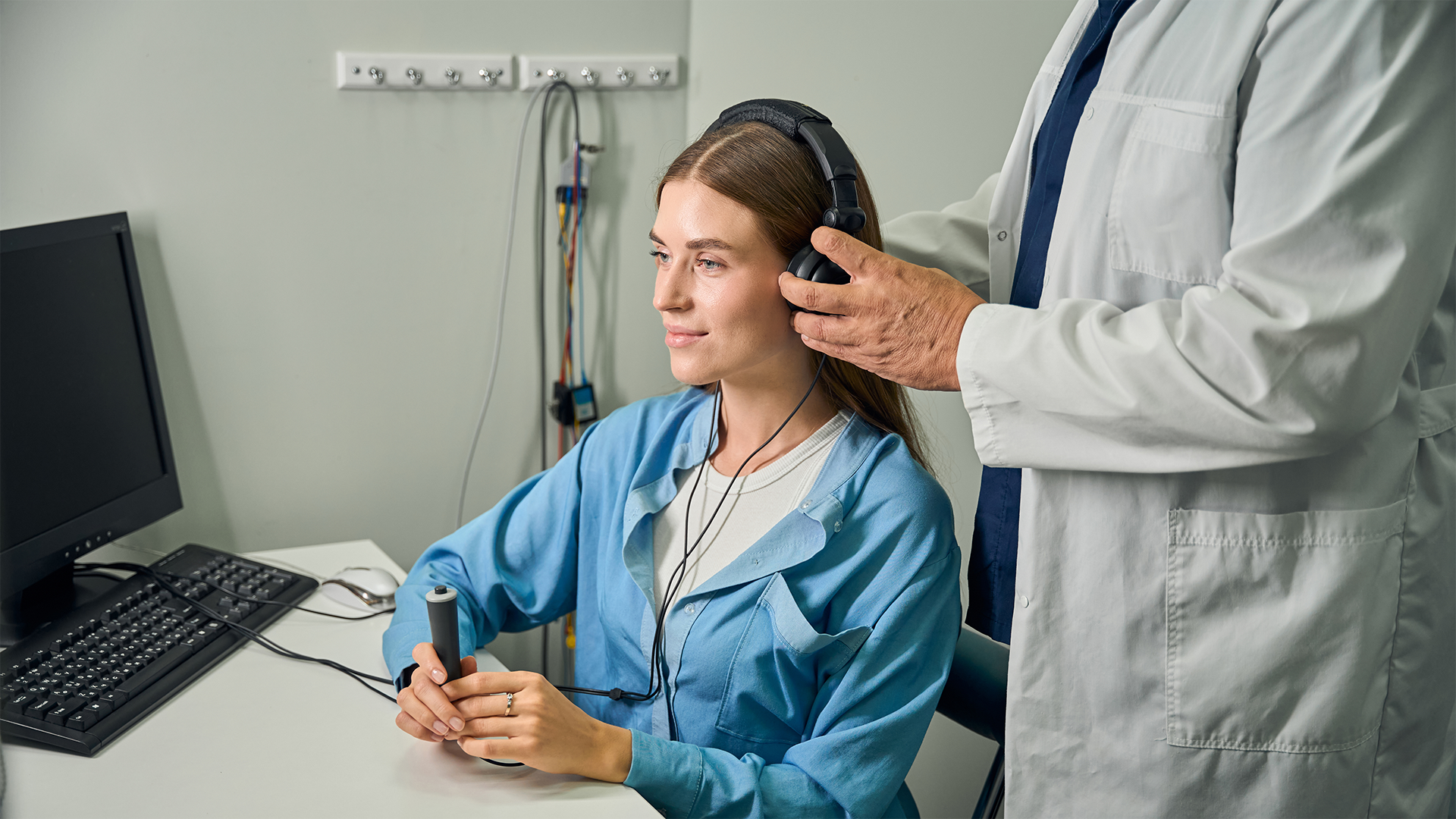
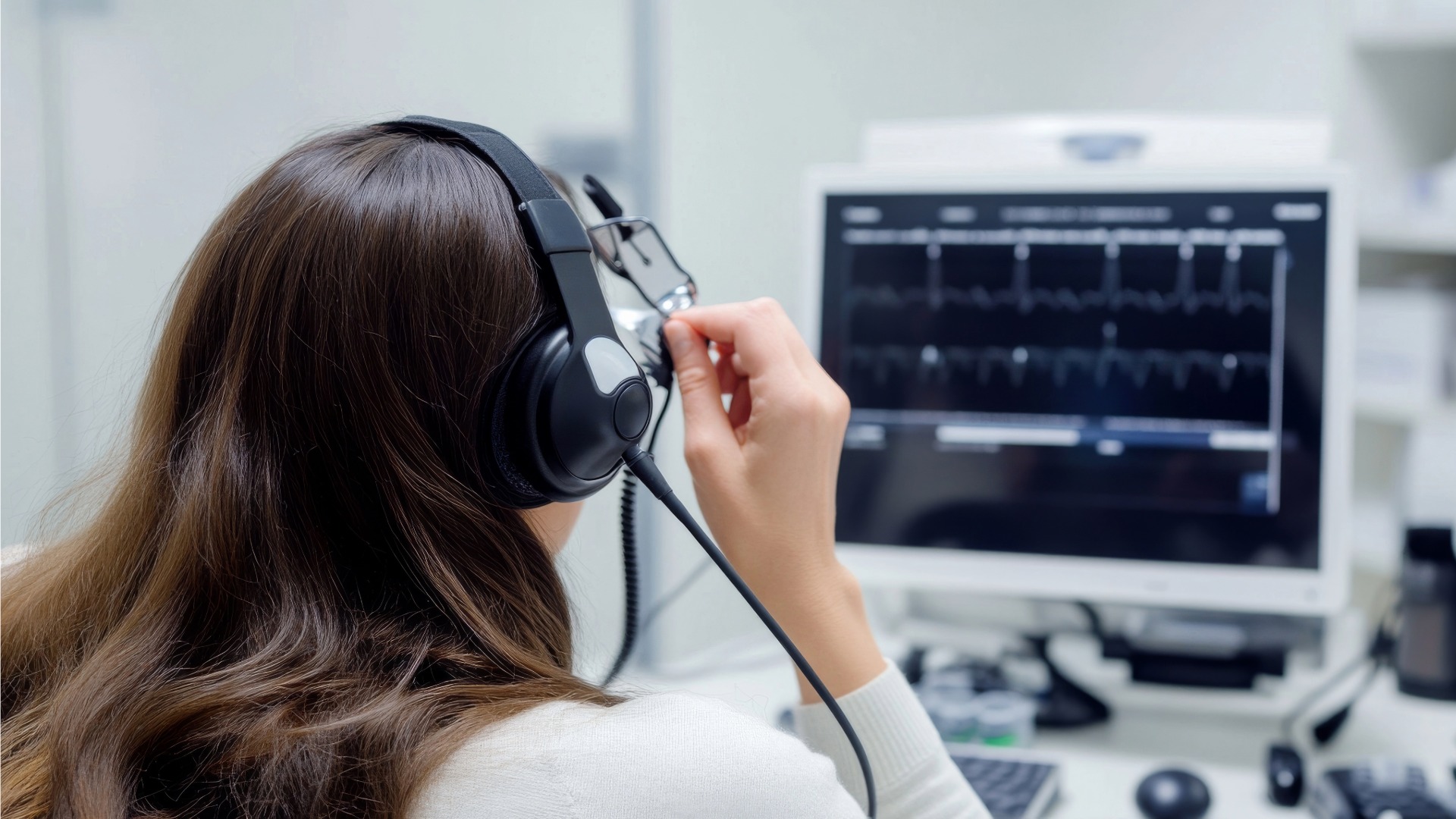
A well-run speech-in-noise assessment should feel calm and straightforward. You listen to speech material with background noise present and repeat what you hear. The clinician adjusts the level relationship between speech and noise or uses a fixed protocol, depending on the test. You are not being judged. The test is measuring how demanding that listening task is for your auditory system. The results are then explained in plain English: what your scores suggest, how that compares to typical expectations, and what it means for your next step. For some people, the outcome is reassurance and a baseline. For others, it supports a hearing aid trial, or a refinement of settings, or a discussion about remote microphones for specific situations. The aim is practical clarity, not a pile of numbers.
When speech-in-noise results suggest a broader check
Most noise difficulty is explained by the common mix of hearing loss and complex listening environments. Sometimes, though, additional assessment is sensible, particularly when symptoms are one-sided, sudden, accompanied by persistent ear pressure, pain, discharge, or significant dizziness. Speech-in-noise testing does not diagnose medical conditions, but it can contribute to the overall picture that guides whether ENT input is appropriate. A good clinic uses the results as one piece of evidence, not as a standalone label.
Clarity where it matters most
If you feel fine in quiet but struggle in real life, speech-in-noise testing can be the missing piece. It measures the problem you actually notice, validates the experience, and helps build a plan that fits your routine. It can guide hearing aid selection and Signia-friendly fitting strategies, support meaningful fine-tuning, and highlight when accessories such as remote microphones are likely to give you a real advantage. Most importantly, it replaces guessing with a clearer explanation and a calmer next step.
References
- https://www.thebsa.org.uk/wp-content/uploads/2023/10/OD104-80-BSA-Practice-Guidance-Speech-in-Noise-FINAL.Feb-2019.pdf
- https://pmc.ncbi.nlm.nih.gov/articles/PMC10872656/
- https://pmc.ncbi.nlm.nih.gov/articles/PMC10583951/
- https://www.interacoustics.com/academy/audiometry-training/advanced-tests/audible-contrast-threshold-test
- https://audiocare.pt/speech-in-noise-act-test/
- https://www.nice.org.uk/guidance/ng98