


Table of Contents
Not every hearing loss arrives with an obvious cause. Some develop so quietly, and look so ordinary on examination, that they are easily put down to age or never investigated at all. Otosclerosis is one of those conditions. It tends to creep in over months or years, the eardrum usually looks entirely normal, and it often begins in people far younger than the typical age for age-related hearing loss. For all those reasons it is frequently overlooked, yet it is one of the more common causes of hearing loss in younger adults, and it responds well to treatment once it is identified.
As an audiology and ENT clinic, we see otosclerosis often enough to know how much difference a clear explanation makes. This guide sets out what the condition is, who tends to develop it, how it is diagnosed, and the options for managing it.
What Otosclerosis Actually Is
Deep inside each ear sit three tiny bones, the ossicles, which pass sound vibrations from the eardrum towards the inner ear. The smallest of them, the stapes, is shaped a little like a stirrup and sits right at the entrance to the cochlea. In otosclerosis, the bone around this region undergoes abnormal remodelling, with existing bone being broken down and replaced by new, denser bone. As that new bone builds up around the base of the stapes, it gradually fixes the stirrup in place so that it can no longer vibrate freely.
When the stapes cannot move properly, sound is no longer carried efficiently into the inner ear. The result is a conductive hearing loss, which means the difficulty lies in the mechanical transmission of sound rather than in the hearing nerve itself. In a minority of cases the process spreads further, into the cochlea, and can add a sensorineural component, producing a mixed hearing loss. That is less common, but it is part of why an early assessment matters.
Who It Affects, and Why It Goes Unnoticed
Otosclerosis usually makes itself known in early to middle adulthood. Most people first notice a problem in their twenties or thirties, although it can appear earlier or later. It affects women roughly twice as often as men, it frequently runs in families, and symptoms are often reported to progress more quickly during pregnancy, which points to a hormonal influence sitting alongside the genetic one. UK estimates of how many people are affected vary, but it is far from rare.
Part of what makes it easy to miss is the pattern of the loss. Age-related hearing loss tends to take the high-pitched sounds first, whereas otosclerosis often begins with the lower pitches. Some people even notice, early on, that they seem to hear better in a busy, noisy room than in a quiet one, and some find their own voice sounds loud to them, so they start to speak more softly. Because the eardrum looks normal and the change is so gradual, the condition can progress quietly before anyone thinks to look for it.
The Signs Worth Noticing
The central symptom is a slow, steady decline in hearing, usually in both ears though not always to the same degree. Tinnitus, a ringing or buzzing in the ear, is very common alongside it. Dizziness or a sense of imbalance can occur but is much less typical. None of these features on its own confirms otosclerosis, since they overlap with several other conditions, and that is precisely why they are worth having assessed rather than guessed at. If your hearing has been slipping gradually, particularly if you are in your twenties, thirties or forties, or if otosclerosis runs in your family, it is sensible to arrange a proper hearing evaluation rather than to wait and see.
How It Is Diagnosed
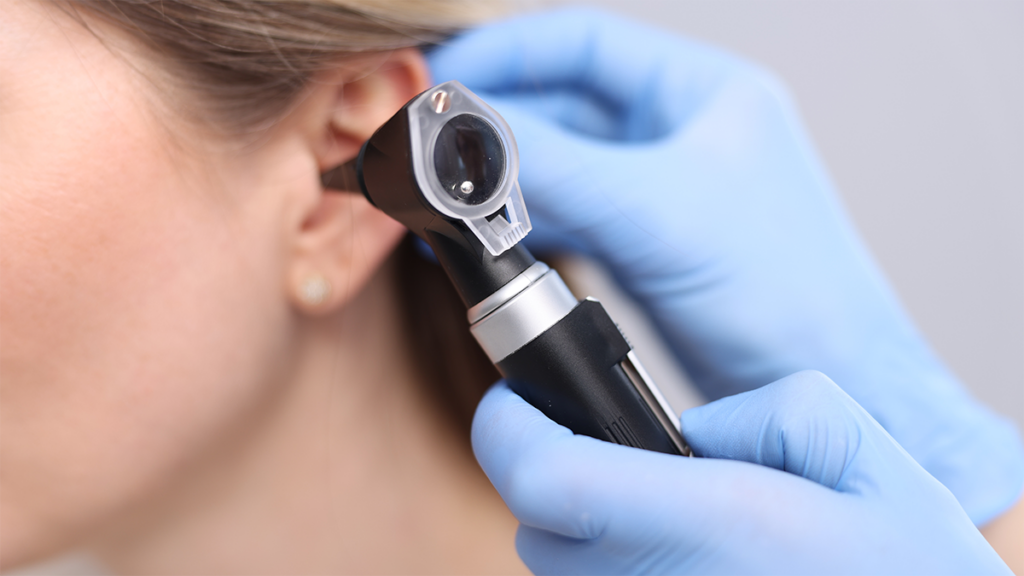
Diagnosis rests on a careful history together with a set of hearing tests, rather than on any single result. The examination usually begins with otoscopy, a look into the ear canal, which in otosclerosis typically reveals a normal eardrum. Occasionally a faint pink tinge is visible over the inner ear wall, a feature known as the Schwartze sign, reflecting a more active, vascular phase of the disease. Tuning fork tests give an early indication of whether a loss is conductive in nature.
The key investigation is pure-tone audiometry. In otosclerosis this characteristically shows a conductive loss, often more marked in the lower frequencies to begin with. A particular pattern called the Carhart notch may appear, a dip in the bone-conduction results in the region of 2,000 Hz. It is worth knowing that this notch is a mechanical artefact caused by the fixed chain of bones rather than true nerve damage, and it often improves after successful surgery. Tympanometry, which measures how the eardrum responds to changes in pressure, and tests of the stapedial reflex add further detail, and a CT scan of the temporal bone is sometimes used when the picture is unclear. Taken together, these tests are what separate otosclerosis from the other causes of a gradual hearing loss.
How It Is Managed
There is no single right answer here, and the best approach depends on how much the hearing is affected and on personal preference. When the loss is still mild, no immediate treatment may be needed beyond keeping an eye on it over time. As it progresses, there are two main routes.
The first is hearing aids. Because the inner ear and the hearing nerve are often working normally in otosclerosis, well-fitted hearing aids can manage the conductive loss effectively and without any surgery. This is where much of our day-to-day work sits: assessing the hearing accurately and, where aids are appropriate, fitting and verifying Signia devices so that the amplification genuinely suits the individual ear. The second route is surgery. An ENT surgeon can carry out a stapedotomy or stapedectomy, in which the fixed stapes is bypassed or replaced with a small prosthesis so that sound can once again reach the inner ear. These operations have high success rates in suitable patients, although, like any ear surgery, they carry a small risk of further hearing loss in the operated ear, on the order of one to two per cent. Medication has also been tried, with sodium fluoride and related drugs used in an attempt to slow active disease, but the evidence for this remains limited and it is not a cure.
Why an Early Assessment Pays Off
The awkward thing about otosclerosis is also the reassuring thing: it hides well, yet once it is found it is very treatable. Because the loss is gradual and the ear looks healthy, it is easily mistaken for the ordinary effects of getting older, especially in someone who is not expecting hearing trouble in their thirties. A thorough audiological assessment is what tells the difference, and it opens the door to the full range of options, from a well-matched hearing aid through to a surgical referral.
If your hearing has been fading slowly and you are not sure why, there is no need to put up with it or to assume the worst. At AudioCare in Guia we can carry out the hearing tests, examine the ear, and where it is needed arrange the right ENT input, so that whatever lies behind the change, you leave with a clear picture and a sensible plan. Following the markets, the cafés and the everyday conversations of life on the Algarve is a good deal easier when you can hear what is being said.