

Table of Contents
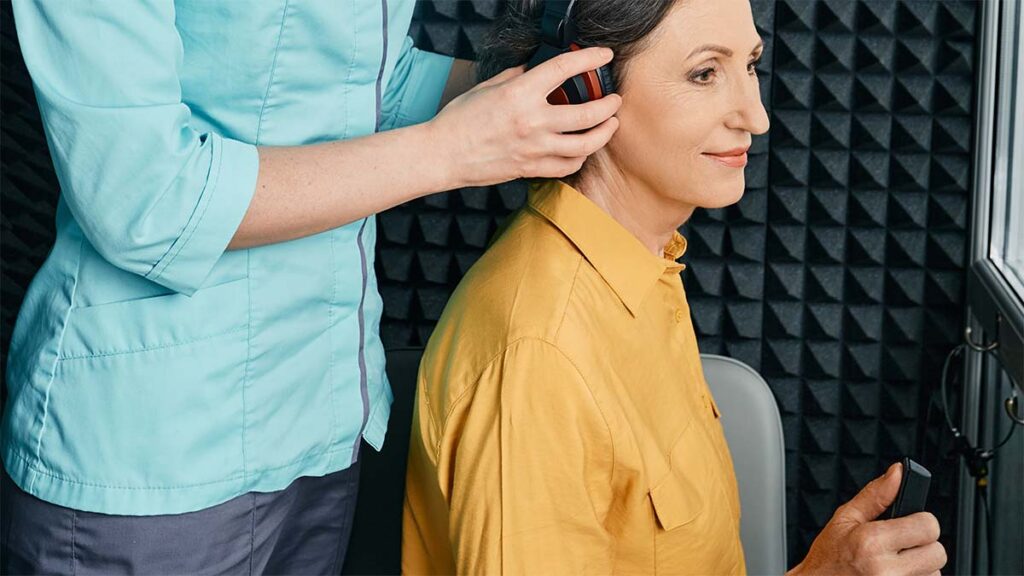
During a hearing test, people are often told to press the button whenever they hear a sound, even if it is extremely faint.
That last part matters.
Pure-tone audiometry is not trying to find the volume at which sound becomes comfortable or obvious. It is looking for the boundary between sounds that can be detected reliably and sounds that are too soft to hear.
Audiologists call that boundary the hearing threshold.
“Softest sound you can hear” is a useful shorthand, but the actual measurement is more careful than that phrase suggests. A threshold is not based on one uncertain response to one very quiet tone. It is established by presenting sounds repeatedly, changing their level in a controlled way and looking for a consistent pattern.
That threshold then becomes one of the basic measurements used to describe hearing sensitivity.
A threshold is a boundary, not a perfect dividing line
Hearing is not like switching a light on and off.
Near threshold, a sound may be heard on one presentation and missed on another. Attention, familiarity with the task and the natural variability of human responses all play a part.
For that reason, audiologists do not define threshold as the faintest sound someone manages to detect once.
In conventional pure-tone audiometry, threshold is established as the lowest hearing level at which the person responds consistently enough during repeated ascending presentations.
British Society of Audiology and ASHA procedures use a criterion based on responses during at least half of those ascending presentations, with a minimum number of successful responses required before the threshold is accepted.
That definition is important because it recognises that hearing at the edge of audibility contains some uncertainty.
The result is therefore best thought of as a clinical estimate of hearing sensitivity at that frequency, obtained under controlled conditions.
It is precise enough to be extremely useful, but it is not pretending that the ear has an absolutely fixed boundary that never varies by a few decibels.
How does the audiologist actually find that point?
The test usually begins with a sound that is clearly audible so that the person understands what they are listening for and how to respond.
Once the task is clear, the audiologist begins searching for the threshold.
A commonly used method follows a simple pattern. After the person hears a tone, its level is reduced. Once it becomes too soft to hear, the level is increased again in smaller steps.
This is often described as a “down 10, up 5” procedure.
After a response, the level is typically reduced by 10 dB. After no response, it is increased in 5 dB steps until the sound is detected again.
The process is repeated.
Why not simply keep making the sound quieter until the person stops responding and record that point?
Because a single transition from “heard” to “not heard” could be influenced by hesitation, attention or chance.
Approaching the threshold several times from below allows the audiologist to see whether responses recur at approximately the same level.
The person being tested does not need to judge whether a sound is “definitely loud enough”. In fact, waiting for certainty can make the measured threshold appear poorer than it really is.
The instruction is usually much simpler: respond whenever a sound is heard, however faint it seems.
Why measure the quietest detectable sound rather than a comfortable one?
Because the clinical question is sensitivity.
If a sound has to be made louder before one person can detect it than another, that difference tells us something about access to sound at that frequency.
Measuring thresholds across the conventional audiometric range creates the pattern shown on the audiogram.
The audiologist can then see whether hearing sensitivity is broadly similar across frequencies or whether some parts of the range require considerably more sound before they become audible.
That information is much harder to obtain by asking whether a sound feels “comfortable”.
Comfortable loudness is a different measurement.
Two people can detect a sound at similar levels but have different preferences for how loud they want everyday sound to be. Conversely, someone can have elevated hearing thresholds while still finding sufficiently loud sounds perfectly comfortable.
Threshold audiometry therefore deliberately focuses on the lower edge of hearing.
It establishes what becomes audible before asking other questions about speech, comfort or communication.
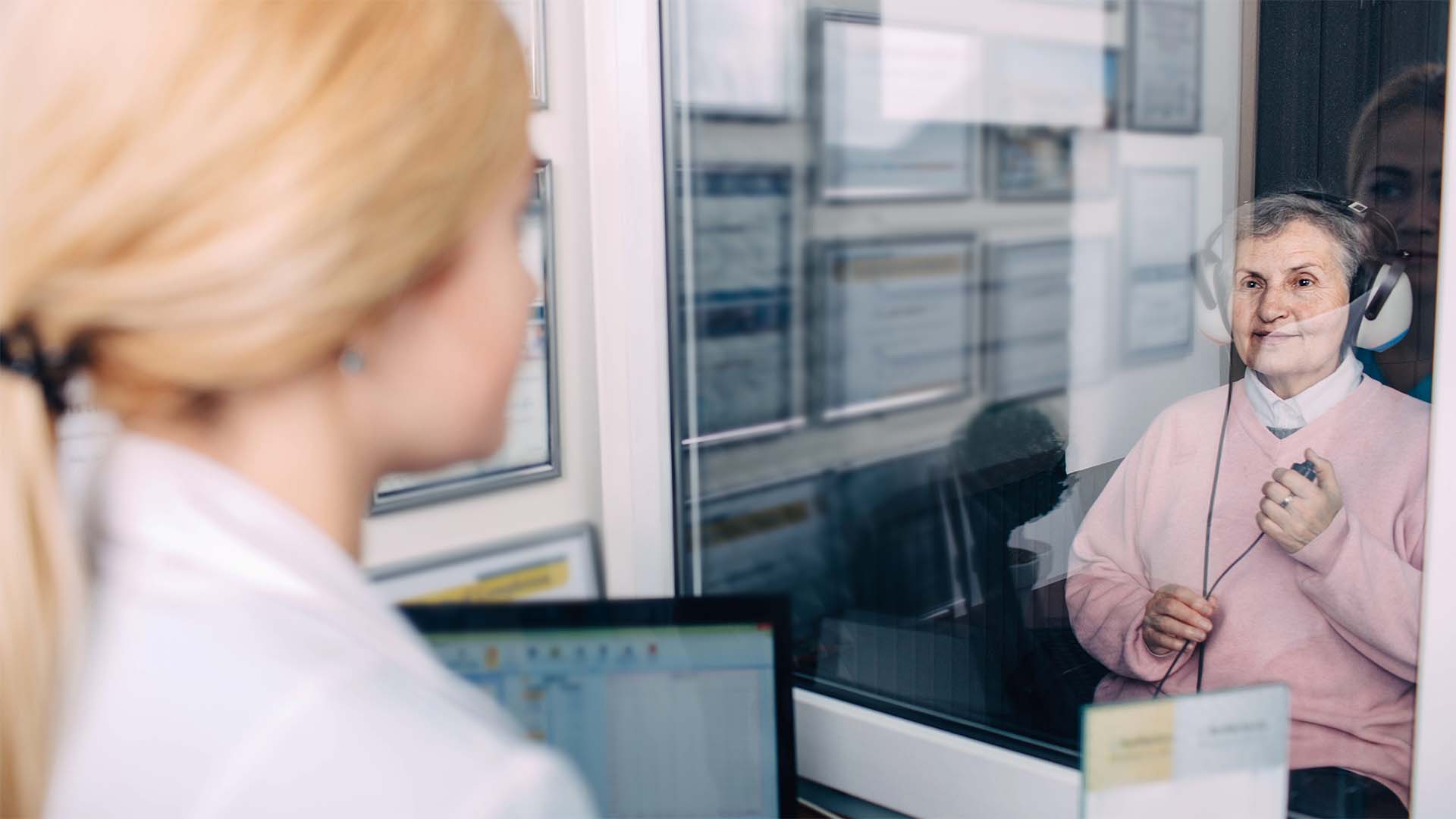
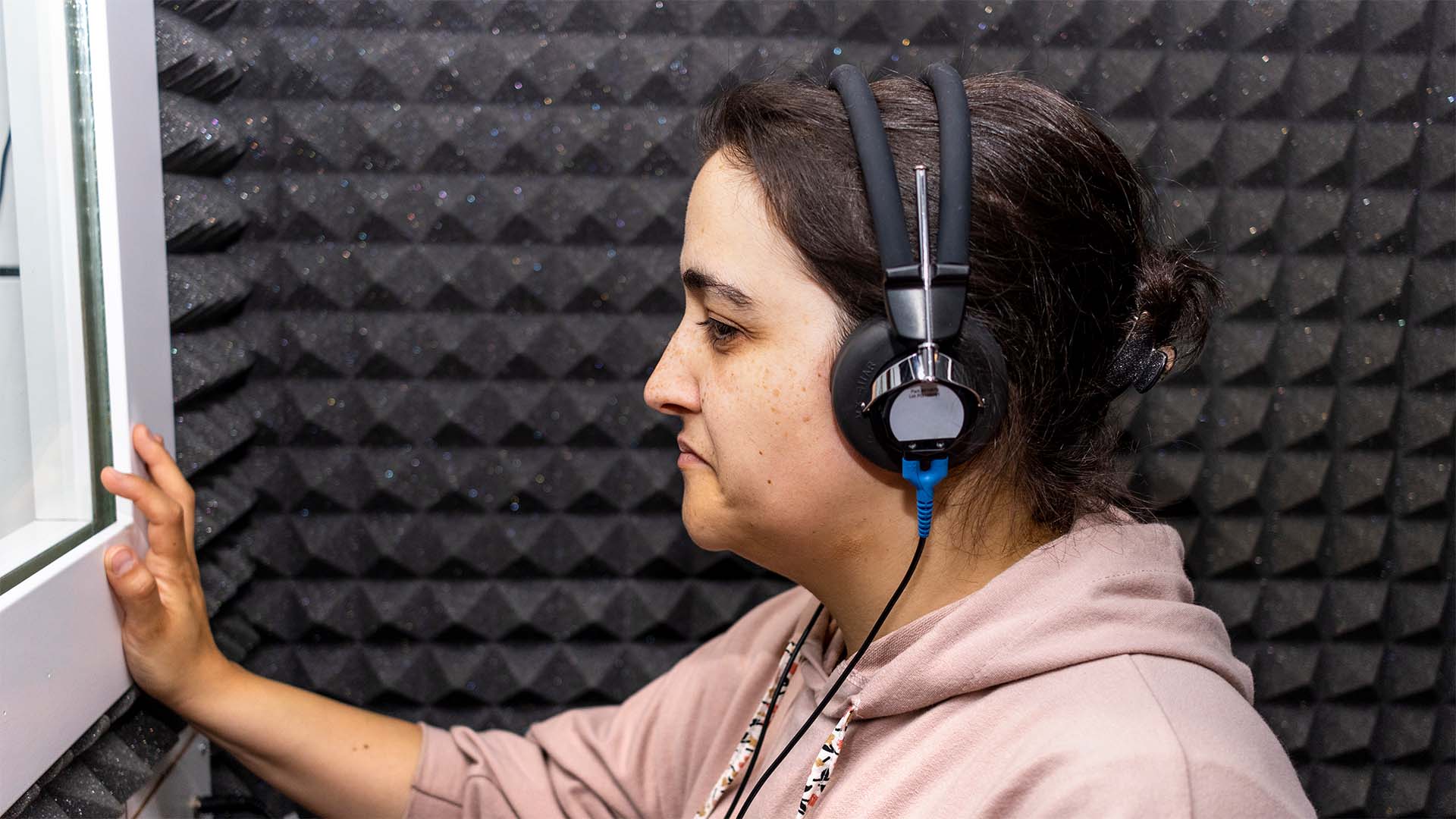
This also explains why the test takes place in a controlled acoustic environment. When the sounds being measured are deliberately very quiet, external noise can interfere with the result.
The threshold does not tell us how well someone understands speech
This is one of the most important limits of the audiogram.
Detecting a simple tone and understanding a sentence are not the same task.
A threshold tells us how sensitive the auditory system is to calibrated sounds at particular frequencies. It does not directly measure how accurately someone recognises words, separates a voice from competing conversation or follows rapid speech.
Someone may have only a small change in pure-tone thresholds yet describe significant difficulty in demanding listening situations.
Another person may have a clearly measurable hearing loss but communicate relatively well in certain quiet environments.
Neither experience makes the audiogram wrong.
The audiogram and the real-life complaint are describing different aspects of hearing.
When necessary, speech audiometry or other tests can be used alongside pure-tone thresholds to explore those additional questions.
This is why an audiologist should not interpret a hearing threshold in isolation.
The numbers need to be considered alongside the person’s hearing history, symptoms and communication difficulties.
Small differences do not automatically mean hearing has changed
Thresholds are usually measured clinically in 5 dB steps.
That already tells us something important about how results should be interpreted.
If a threshold is measured at 15 dB HL on one occasion and 20 dB HL on another, that does not automatically demonstrate a meaningful deterioration.
Behavioural hearing tests contain a degree of normal test-retest variation.
People become more familiar with the task. Concentration changes. A tone sitting close to threshold may be heard during one presentation and missed during another.
This is also why routine audiometry includes checks for consistency.
For example, the threshold at 1000 Hz is commonly measured again after several other frequencies have been tested. If the two results differ more than expected, the audiologist may repeat part of the test, reinstruct the patient or investigate why the measurements are not agreeing.
The wider pattern matters far more than treating every 5 dB difference as a clinical event.
A clear change across several frequencies, a new difference between the ears or a result that does not fit previous findings deserves more attention than one isolated small variation.
Audiometry is quantitative, but interpretation still requires judgement.
The threshold is the starting point, not the whole answer
There is a reason pure-tone audiometry has remained one of the foundations of hearing assessment.
Finding the lowest levels at which sounds can be detected provides a structured, repeatable way to measure hearing sensitivity and compare results between frequencies, between ears and, when appropriate, over time.
But the strength of the audiogram also depends on understanding what it represents.
It does not measure hearing as a percentage.
It does not tell us how loud everyday sounds feel.
It does not reproduce a conversation in a restaurant.
And it does not reduce a person’s hearing to a single number.
At AudioCare, pure-tone thresholds are interpreted as one part of the wider audiological assessment.
The test begins by asking a deliberately narrow question: how soft can a sound become before it can no longer be detected reliably?
Answering that question carefully gives the audiologist a reference point.
From there, the more complicated questions about hearing can begin.